

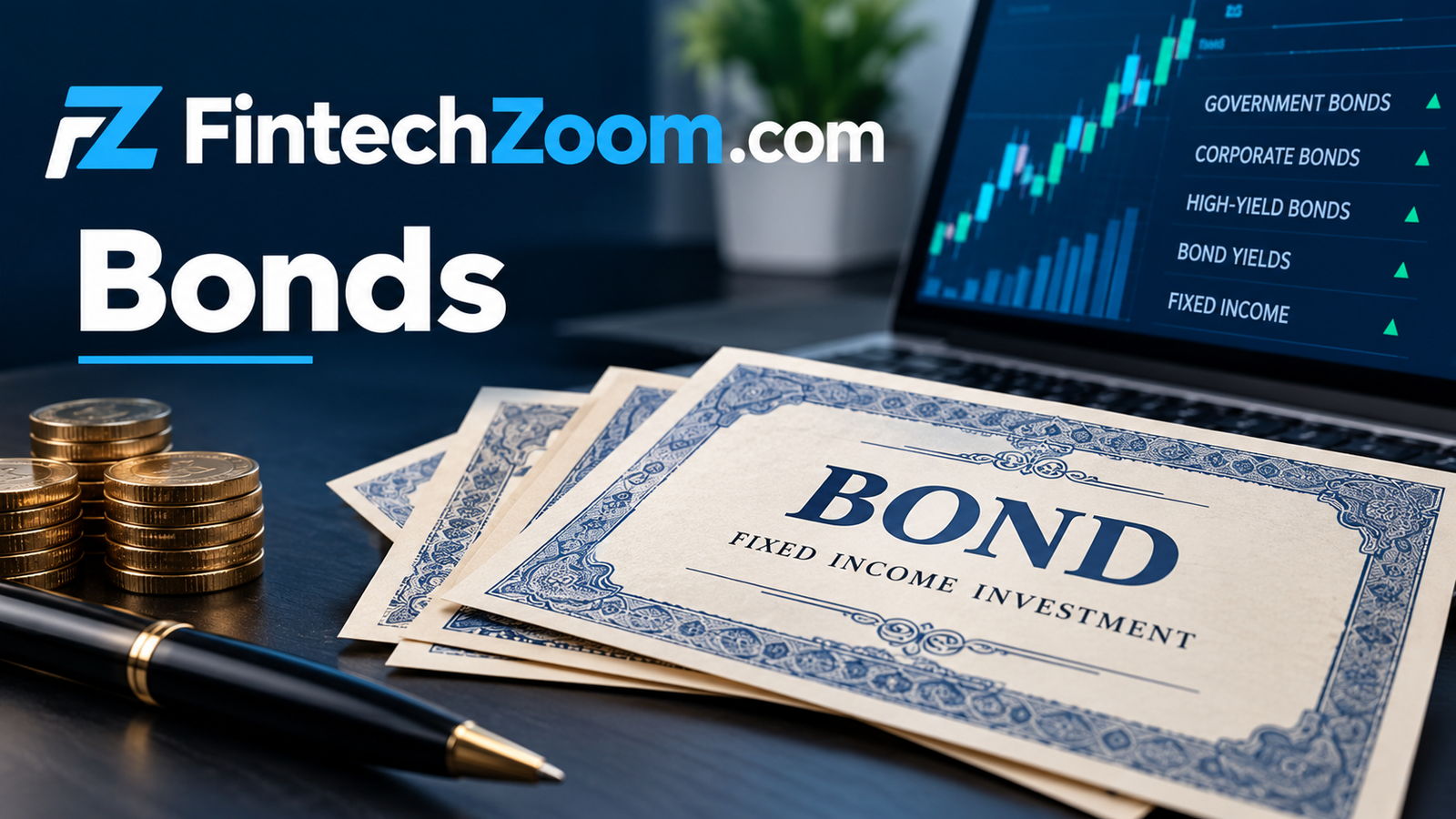
Bonds are back at the center of financial news. After years in the background, they now make headlines as yields reach levels not seen in decades. If you have searched for “fintechzoom.com bonds,” you are probably trying to understand this market and what it means for your savings. The phrase points to the bond-related news, yield quotes, and commentary on FintechZoom.com, a financial news and market information website. This guide explains the basics in simple language, walks through what has happened in the bond market in 2026, and shows how to use market news wisely. Everything here is educational and not personal investment advice.
What Fintechzoom.com Bonds Actually Refers To
When people type “fintechzoom.com bonds” into a search engine, they usually want the bond section of the site, which covers Treasury yields, interest rate expectations, and the economic stories behind them. It does not refer to a special type of bond. A bond is simply a loan you make to a government or a company, and those issuers sell their bonds through regulated channels such as brokerage firms, banks, and the U.S. Treasury’s website, TreasuryDirect.
This is worth stating clearly because some pages online suggest that FintechZoom sells or issues bonds. A news site does not do that. If any website or message asks you to send money directly for something called “fintechzoom.com bonds,” treat it as a red flag and stop. The safe way to use a source like this is to learn from it, then place any real trade through a licensed broker or an official government platform.
How Bonds Work in Plain English
When you buy a bond, you lend money for a set period. The issuer promises to pay you regular interest, called the coupon, and to repay your original amount, called the face value or principal, on the maturity date. If you buy a $1,000 bond with a 4 percent coupon, you receive $40 each year until maturity, and then you get your $1,000 back.
The number that matters most is the yield, which tells you the return you actually earn based on the price you paid. A bond bought at a discount to face value has a yield higher than its coupon, while one bought at a premium has a lower yield. Yield to maturity combines the coupon, the price, and the time left into one yearly figure, which is why professionals use it to judge whether one bond is a better deal than another.
Why Bond Prices and Yields Move in Opposite Directions
The most useful rule in bond investing is that prices and yields move in opposite directions. When interest rates rise, newly issued bonds pay more, which makes older bonds with lower coupons less attractive. Their prices fall until their yields match what the market now offers. When news reports describe a bond sell-off, they are describing falling prices and rising yields at the same moment.
How strongly a bond reacts depends on its maturity. A thirty-year bond is far more sensitive to rate changes than a three-month Treasury bill, because you are locked into the same payment for many more years. If you hold a bond to maturity and the issuer stays financially sound, you still collect every coupon and receive your principal back. A drop in market price is then mostly a paper loss, which becomes real only if you sell early.
The 2026 Bond Market: A Year of Rising Yields
This year has been dramatic for U.S. Treasuries, and it is the main story behind searches for fintechzoom.com bonds. The 10-year Treasury yield started 2026 near 4.15 percent, and many Wall Street banks had expected the Federal Reserve to cut rates. Instead, rising energy prices linked to tensions in the Middle East, a strong job market, and inflation that has stayed above the Fed’s 2 percent goal for years changed the picture. Yields climbed through the summer and reached about 4.70 percent in late July, the highest since January 2025.
September brought the biggest moves. The 10-year yield broke above 5 percent in mid-September, touching about 5.04 percent on September 15, the highest level since 2007. The next day, the Fed raised its benchmark rate by a quarter of a percentage point, its first increase since 2023, and policymakers signaled that one or two more hikes could follow. Yields then pushed higher still, with the 10-year reaching about 5.11 percent on September 23 and roughly 5.33 percent on October 1, the highest since early 2002. The 30-year yield climbed to around 5.67 percent, and the 2-year yield was near 4.91 percent. By the next session the 10-year had eased toward 5.24 percent, a reminder of how quickly these numbers change.
What High Yields Mean for Your Money
Higher yields cut both ways. For anyone buying bonds today, the news is good, because new Treasuries and high-quality corporate bonds pay noticeably more income than they did a year ago. Savers who keep cash in low-paying accounts may find that short-term Treasuries and certificates of deposit deserve a closer look.
The downside shows up in borrowing costs and in existing portfolios. The 10-year Treasury yield is a benchmark that lenders use when pricing mortgages, so average 30-year mortgage rates have moved above 7 percent. Stock valuations also tend to come under pressure when yields rise, because safer bonds become more competitive with shares. People who already own long-term bonds or bond funds may see their account values dip. The U.S. Treasury has also expanded its buyback operations to help calm the market, which shows how closely policymakers are watching.
The Main Types of Bonds in Market Coverage
Treasury securities form the backbone of most bond news. Bills mature within a year, notes run from two to ten years, and bonds stretch to twenty or thirty years. Treasury Inflation-Protected Securities adjust their principal with inflation, and Series I savings bonds, available through TreasuryDirect, pay a rate that blends a fixed portion with an inflation-linked portion. Electronic I bond purchases are limited to $10,000 per person each calendar year.
Outside the federal government, municipal bonds raise money for schools, roads, and local projects, and their interest is often exempt from federal income tax. Corporate bonds come in two broad groups: investment-grade bonds from financially strong companies, and high-yield bonds from riskier ones that pay more to make up for a higher chance of default. Knowing which type a headline discusses helps you decide whether it affects you at all.
How to Read Bond Quotes and the Yield Curve
A bond quote usually lists the issuer, coupon rate, maturity date, price, and yield. Prices are shown as a percentage of face value, so a quote of 98 means the bond trades at 98 percent of its par amount. Credit ratings from agencies like Moody’s, S&P Global, and Fitch give a quick view of default risk, with higher ratings signaling a safer issuer.
The yield curve plots yields across different maturities. Normally it slopes upward, because lenders want extra pay for locking up money longer. When short-term yields rise above long-term yields, the curve is called inverted, a pattern that has often appeared before economic slowdowns. The U.S. Treasury publishes its official daily yield curve every business day in the late afternoon, which makes it a dependable place to double-check any number you see in a news article.
Smart and Safe Ways to Invest in Bonds
The most direct way to buy government debt is through TreasuryDirect, which charges no commission. Most brokerages also sell Treasuries, corporate bonds, and municipal bonds, and many investors prefer bond mutual funds or exchange-traded funds for easy diversification. Funds do not have a maturity date, so their value keeps moving with interest rates, while an individual bond returns your principal at maturity.
Before investing, check that your broker is registered using FINRA BrokerCheck, and look up municipal bond documents on the MSRB’s EMMA website. Compare any price you are quoted with recent trades, because dealer markups can vary. Many investors also build a bond ladder, buying bonds that mature in different years so that money regularly comes due and can be reinvested at current rates. This approach reduces the pressure of guessing where yields will go next.
Conclusion
Bonds are simple at their core: you lend money, collect interest, and get your principal back at maturity. What makes 2026 different is how fast yields have climbed, with the 10-year Treasury moving from about 4.15 percent in January to above 5.3 percent in early October, driven by inflation worries, energy prices, and the Fed’s first rate hike in three years. Higher yields offer better income to new buyers, while raising borrowing costs and putting temporary pressure on existing bond prices.
Fintechzoom.com bonds coverage can help you follow these changes, but it works best as a learning tool rather than a place to buy or a trigger to act on every headline. Set a clear goal, understand the risks of interest rates, inflation, and credit, confirm numbers with official sources like the U.S. Treasury and the Federal Reserve, and buy only through trusted, regulated channels. Because yields move daily, check live figures before making any decision, and consider speaking with a licensed financial advisor if you need advice tailored to your situation.
